Key Changes to Class Q Permitted Development Rights (2026 Update)
We help landowners and homeowners build eco-homes, extend their homes, and create unique holiday homes that gain planning permission and pay them back. RIBA Chartered Architects.
Class Q Barn Conversion Rules — Introduction
Class Q permitted development rights allow agricultural buildings to be converted into homes without the need for a full planning application. Introduced in 2014, the regulations were substantially rewritten in May 2024, and those rules, now fully embedded, with the transitional window for old-rules applications long closed, have widened eligibility in some areas and tightened it in others, pulling schemes back from new-build territory towards genuine conversion.
When used correctly, Class Q remains one of the most efficient routes to delivering a high-quality rural home. However, it is a policy that is often misunderstood, which often results in denied prior approvals, aborted projects, and costly redesigns once technical constraints become apparent.
In this guide, I'll explain how Class Q works in 2026, what the current regulations actually allow, and how to assess whether your barn conversion is genuinely viable before you commit time or money.

A contemporary barn conversion achieved through Class Q permitted development, dark timber cladding, generous glazing, and a considered material palette that sits naturally in a rural landscape.
What Is Class Q?
Class Q is part of the General Permitted Development Order, the legislation that grants planning permission for certain types of development without a planning application. In exercising it, you are using permitted development rights that already exist on your land, rather than asking the council for permission.
That distinction matters less in practice than people expect. Class Q still requires a prior approval application, and that application feels a lot like a planning application. You must evidence the building's history, its structural capacity, and the conversion works in a documented submission, in much the same way a Design and Access Statement evidences and equips a full planning application.
Class Q Barn Conversion — Eligibility Checklist
Agricultural use: Was the building part of an established agricultural unit on or before 24 July 2023? Evidence such as tenancy agreements, aerial photographs, planning records, and even bank receipts is essential before relying on Class Q. Buildings brought into agricultural use after that date face a 10-year qualifying period.
Buildings no longer on a farm: A barn that has since left the agricultural unit may still qualify. Eligibility turns on when it ceased to form part of the unit and what it has been used for since.
Building condition: Is the structure genuinely capable of conversion without being substantially rebuilt? Class Q permits conversion, not reconstruction. If the building needs a new structural frame, it is unlikely to pass prior approval; more on this below.
Access: Does the site have existing suitable access to a public highway? Creating new access is not permitted under Class Q, and highway refusals are extremely difficult to get past. That said, a separate planning application for the access itself is sometimes an option.
Scale: Are you proposing ten dwellings or fewer, with a combined floor area within the 1,000m² limit, and no single dwelling over 150m²?
Location: Class Q does not apply in National Landscapes (formerly AONBs), National Parks, the Broads, conservation areas, or World Heritage Sites. It also does not apply to listed buildings or buildings within their curtilage, scheduled monuments, or SSSIs. This is an exclusion, not a restriction. If your barn sits in the Cotswolds National Landscape, Class Q is off the table, and the conversation moves to a full planning application or, for exceptional new dwellings, policy HO11 (previously paragraph 84).
Subject to permitted development: If you are purchasing a site on the assumption that Class Q applies, get that confirmed before you exchange. I have seen buyers purchase on the hope that a barn "should" qualify, only to find out post-purchase that it doesn't. Permitted development rights are not guaranteed simply because a building looks like a barn.
P.S. If you are considering a Class Q barn conversion or if you are not sure how you can use your land, you can download our free guide to learn more.
Class Q Barn Conversion Rules — Key Changes
Broader Eligibility of Buildings
This is the headline change, and the one most commonly missed. Class Q now extends to former agricultural buildings that no longer form part of an agricultural unit, previously a hard exclusion. And for buildings still on an agricultural unit, the old requirement that the building was used solely for agriculture has been removed. A barn that has been part-used for storage, let out, or hived off the holding entirely may now qualify, provided the use history stacks up against the 24 July 2023 cut-off.
Eligibility turns on documented use history, and the buildings that sail through prior approval are the ones where that evidence was assembled before the application.
Increased Number of Dwellings
Up to 10 dwellings can now be created under Class Q within a single agricultural unit, provided the total combined floor area does not exceed 1,000m². This has shifted many projects away from single large houses towards multiple smaller dwellings, often improving both deliverability and planning outcomes. This change is more suited to developers than homeowners.
Reduced Maximum Floor Area per Dwelling
Each dwelling is now limited to 150m², down from the previous allowance of up to 465m². This reinforces the principle that Class Q is intended for modest homes created through genuine conversion, not large countryside residences, which are achieved by other routes, such as policy HO11. At 150m², good design and a considered spatial arrangement matter even more. Poorly planned layouts waste space that simply isn't there to waste.
Permissible Rear Extensions
Single-storey rear extensions of up to 4 metres are now permitted, but only on hardstanding that was in place on or before 24 July 2023, no taller than 4 metres, no higher than the eaves of the existing building, and no wider than it. The date matters: pouring a slab now does not create the entitlement. Where it applies, this is a meaningful practical improvement, allowing greater flexibility with layouts, daylighting, and living spaces, provided the extension remains genuinely subordinate to the original structure.
Protrusions for Building Operations
The rules now allow protrusions of up to 0.2 metres beyond the external dimensions of the existing building to accommodate the works a conversion actually needs: windows, doors, roof build-ups, external wall insulation, and service connections. A small allowance on paper, but it resolves a long-running grey area that previously caught out schemes at the detail stage, particularly where upgrading the thermal envelope is the point of the project.
Nationally Described Space Standards (NDSS)
All Class Q dwellings must comply with the Nationally Described Space Standards, minimum internal areas, adequate storage, and satisfactory living conditions. Space standards have applied to homes delivered through permitted development since 2021; the current Class Q rules write the requirement directly into the prior approval test. Applying the NDSS will have implications from the outset and often determines how many dwellings a structure can realistically support, as well as the spatial arrangement.
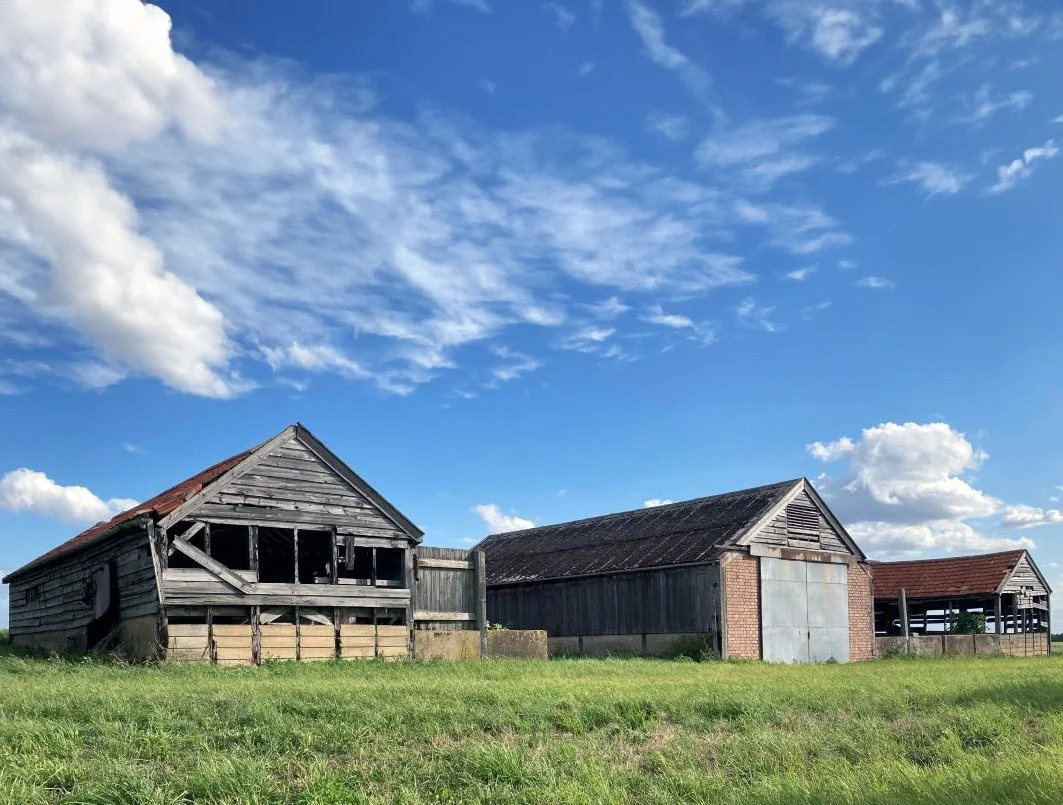
A group of redundant agricultural buildings typical of those assessed for Class Q permitted development. Building condition, evidence of historic use, and existing access all determine whether conversion is viable under Class Q; such due diligence will need to be carried out before undertaking any Class Q application.
Which Buildings Are Suitable for Class Q Conversion?
The vast majority of Class Q refusals come down to two things:
The building was not suitable for conversion in the first place.
The designer could not show the planner how the existing structure would carry the conversion within the limits of Class Q.
The legal test is that the structure must be capable of conversion without works amounting to a rebuild.
Conversion can legitimately include replacing the roof, and even replacing some of the walls; the regulations expressly permit the installation or replacement of windows, doors, roofs, and exterior walls where reasonably necessary. What the existing building must do is carry the conversion structurally. If the frame cannot take the loads of a dwelling, you are not converting a barn; you are building a new house inside the silhouette of an old one, and prior approval will be refused.
In practice, the buildings that struggle are open-sided structures, pole barns being the typical example. As a rule of thumb, around 60–70% of the building should be enclosed for a conversion case to hold together. A solid portal-frame shed with cladding and a roof is a far stronger candidate than a Dutch barn that is mostly fresh air.
There is a second reason suitability cases fail: who is reading them. Class Q applications are assessed by planning officers, and, with respect, planning officers are rarely builders. Most have limited experience with structure and building fabric. If the submission does not explain clearly how the existing frame works, what the conversion works involve, and why they fall short of a rebuild, the officer's doubt fills the gap, and doubt becomes a refusal. The principle I work on every application is to answer the question before it is asked. Remove the officer's doubts before they form, and you avoid the months of back-and-forth that come with having to explain the project, which often results in project delays.
This is why, as part of our Pre-Design work, we prepare a Conversion Method Statement: a clear, evidenced account of whether the building warrants conversion, how the works would be carried out, and what they are likely to cost. It answers the structural question for the planning officer, and, just as importantly, it answers the viability question for you before you fully commit to the project.
Case Study: Class Q Barn Conversion
Black Barn is an eco barn conversion project we are currently working on. The building had been redundant for several years, and the landowner wanted to understand whether conversion to a high-quality, energy-efficient home was viable.
Early feasibility work established the correct planning route, identified the structural constraints that would shape the layout, and confirmed that the access arrangements were sufficient. That early groundwork meant the scheme was structured correctly from the outset.
Conclusion: Is Class Q Right for Your Project?
Class Q is not suitable for every barn or agricultural building; you may, for example, want to also look into Class R. The schemes that succeed are assessed early: the building, its history, its access, its structural capacity and what it will look like and be made of. The schemes that fail skipped that work, and found out at the worst possible time: a refused prior approval, or a structural survey that arrives after the fees are spent.
If you have a barn or agricultural building and are considering whether Class Q might apply, feel free to get in touch with me by either booking a free consultation or sending me an email: peter@markosdesignworkshop.com