
We help landowners and homeowners build eco-homes, extend their homes, and create unique holiday homes that gain planning permission and pay them back. RIBA Chartered Architects.
Ilford Gardens — Adaptable Living Extension, Coventry
Ilford Gardens is an architect-designed accessible home in Coventry, a 150 sqm single-storey extension and full adaptation of an existing bungalow, designed for a client living with a progressive condition similar to motor neurone disease. The project is currently in planning.
The brief was a home that supports independent living now and into the future, without compromise to design, light, or the experience of the garden. RIBA Chartered and ARB registered architect-led from feasibility through planning. Single-storey throughout. Wheelchair accessible across every threshold, every transition, every room.
Before You Spend £100,000 on Your Home… Read This First.
Accessibility Designed in
Most accessible adaptations are visibly added to the house. A ramp was grafted onto a front step. A handrail clamped to a wall. A platform lift dropped into a hallway. The result reads as a compromise, function won, design lost.
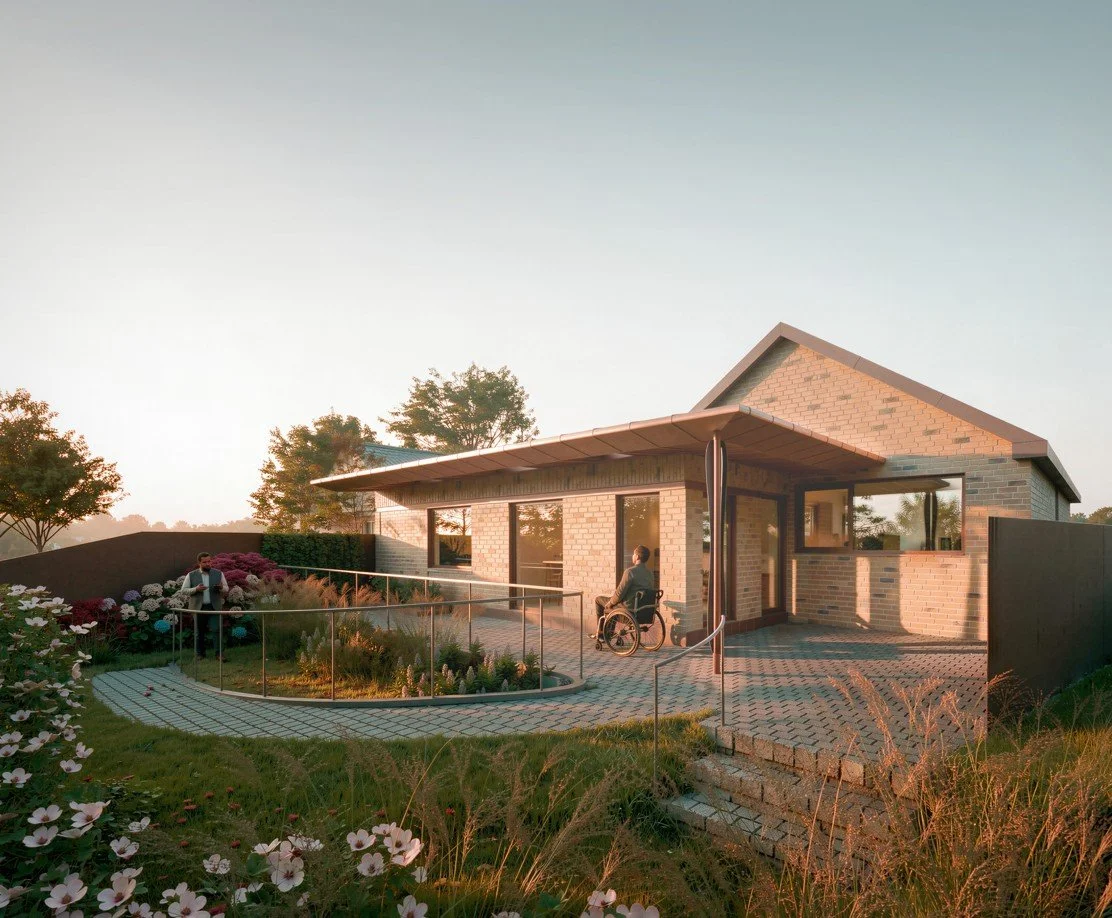
Ilford Gardens starts from the opposite position. The ramp is not a ramp; it is a curved garden path that happens to fall at an accessible gradient, wrapping a planted bed and arriving at the house under a deep, zinc-edged canopy. The handrail is a slim stainless steel line that reads as a garden balustrade. The thresholds are flush. The floors are level. The architecture supports the client; the client does not navigate the architecture.
A south-facing extension built around natural light
The extension is south-facing, oriented to bring natural daylight deep into the principal living spaces. For a client whose mobility is limited and whose time at home is significant, natural daylight is extremely important.
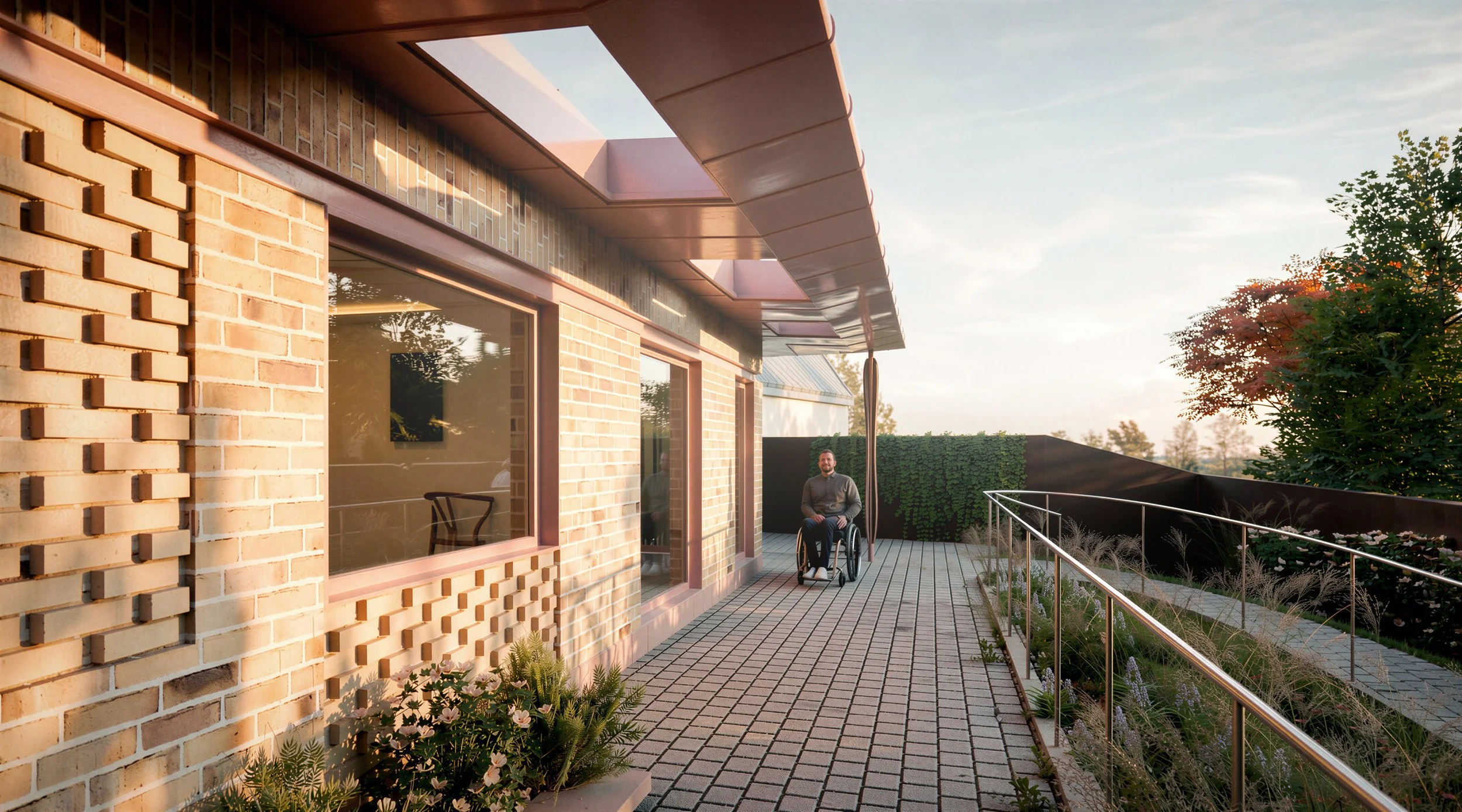
The principal rooms open to the garden through full-height glazing. Rooflights along the canopy bring overhead light into the external walkway. A brick lattice screen filters direct sun and casts a moving pattern across the path throughout the day. The result is a house where light moves with the hours and the seasons, and where every primary space has a direct visual and physical connection to the garden.
Existing bungalow adapted to match
The existing bungalow is being adapted in parallel with the new extension, so the entire 150 sqm reads as one continuous single-storey accessible home. Internal level changes removed. Door widths and circulation routes are set to accessible standards throughout. Bathroom, kitchen and bedroom layouts reconfigured for wheelchair use without reading as a clinical environment.
The adaptation work is as carefully designed as the extension. Both halves of the project hold the same standard — accessible by design, residential in feel.
Material palette — domestic, durable, dignified
Brick exterior with a zinc-edged canopy and zinc detailing at the openings. Stainless rail. Permeable paving for the external walkway. The palette is deliberately domestic and chosen for longevity and low maintenance, recognising that the client's relationship with the house will deepen over time.
Planning strategy — accessible extensions in suburban Coventry
The scheme is being submitted to Coventry City Council as a single-storey rear and side extension to an existing bungalow, with internal adaptations throughout. Single-storey extensions of this kind benefit from a relatively clear policy route under the Coventry Local Plan and standard residential extension policy, and the design has been developed in line with permitted development principles where applicable, with full planning applied for the elements that exceed those thresholds.
The accessibility brief strengthens the planning case. Adapting an existing home to allow a resident with progressive mobility needs to remain in place is exactly the kind of housing outcome the planning system is designed to support.
Why this project matters to the practice
A meaningful proportion of our best work has been for clients who need adaptable living. The brief is exacting, the consequences of getting it wrong are immediate, and the design moves that matter, flush thresholds, generous turning circles, daylight reaching the spaces that get used, are the same moves that make a great house. The constraint produces better architecture, not worse.
Adaptable living is a specialism we take seriously, and a market we actively work in. If you or someone in your family is planning a home that needs to support changing mobility, whether through extension, adaptation, or a new build, we would welcome the conversation early. If you are interested in learning about another adaptable living project we did for an interior adaptable living, you can click here to learn more.