Farm Diversification and Rural Planning Permission: What NPPF Policy E4 Supports
We help landowners and homeowners build eco-homes, extend their homes, and create unique holiday homes that gain planning permission and pay them back. RIBA Chartered Architects.
What policy E4 actually says
Policy E4 of the National Planning Policy Framework (August 2026 edition), previously paragraph 88, directs councils to enable four things: the sustainable growth and expansion of rural businesses, the development and diversification of agricultural and other land-based rural businesses, "sustainable rural tourism and leisure developments which respect the character of the countryside", and the retention of accessible local services.
Simply put, the NPPF actively supports landowners who diversify. Where a new open-market house in the countryside has almost no policy on its side, a well-conceived rural tourism or diversification project has a national policy written in its favour. In this article, we will look at policy E4, what it is, and how it might let you build as part of your farm diversification.
What you can build under policy E4
Policy E4 supports a range of projects that include the following; this is not an exhaustive list:
Holiday accommodation — cabins, lodges and exclusive-use homestays. Rural tourism is named explicitly in the policy at E4(1)(c).
Wellness retreats and saunas — leisure uses, provided the character of the countryside is respected.
Farm shops and cafés — diversification of the existing business.
Equestrian facilities — riding schools, liveries and arenas, as land-based rural businesses.
Tourism and leisure are the uses the policy names directly. The others ride under the diversification and rural-business aspects, and the strength of your case depends on how genuinely the new use grows out of what is already there.
What the list does not include is a home. Policy E4 is a commercial and tourism policy. If you are looking to build an eco-home for residential purposes, there are alternative routes to look into, including: Grey Belt, HO11 and Class Q.
You cannot just buy a plot and claim rural diversification
Policy E4 supports the diversification of established landholdings and rural businesses. A working farm is the cleanest case; a holiday let or farm shop that adds an income stream to an existing agricultural business is precisely what the policy was written for. But it is not limited to farms. An established landowner proposing a tourism use on land they have held and intend to keep can also make the case.
Councils look at your business plan and judge its credibility; therefore, a legitimate business seeking to diversify its income will be seen favourably and stands a good chance of attaining planning approval. Someone aiming to game the system, by buying a paddock or a woodland and then claiming diversification, will be seen through.
You are also required to prove the business case. How does the proposal integrate with the existing holdings? Is there evidence of demand? Can guests reach it through sustainable transport routes other than by car, e.g. walking, cycling, or bus routes? These are the questions a council weighs before deciding whether the application supports the rural economy and therefore qualifies under policy E4.
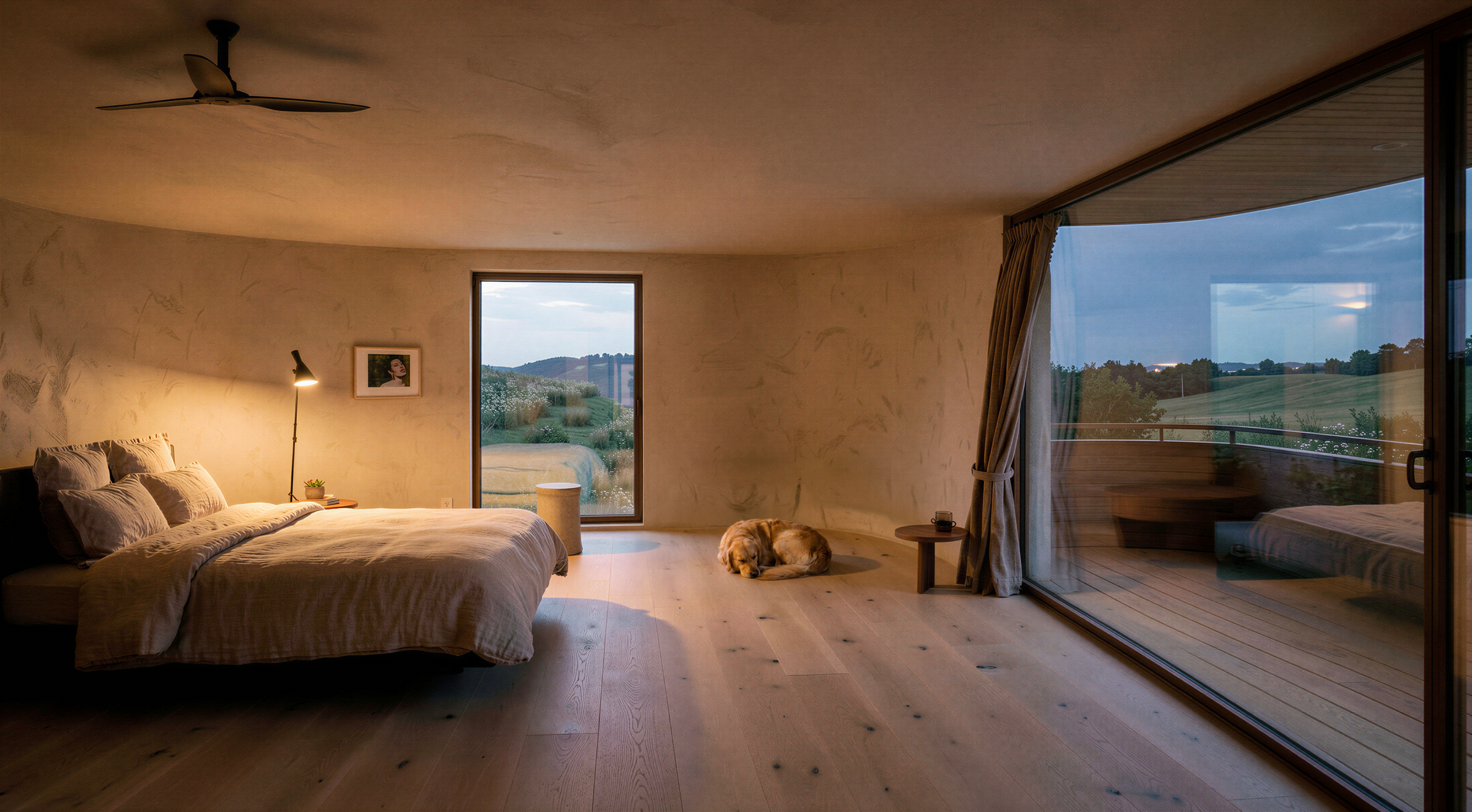
Interior view of one of the bedrooms at The Ridge, which will be built under policy E4.
Case Studies: policy E4 examples
Monocoque Cabin sits on a working dairy farm near Market Drayton, Shropshire, close to a conservation site. Had the project been developed as a house, it would not have got planning permission.
As holiday accommodation tied to the farm business, it did. It has operated since as a successful exclusive-use rental and won an Airbnb OMG! Fund award against tens of thousands of entries. The holiday cabin is restricted to serviced accommodation.
The Ridge is our proposed four-bedroom homestay in the Malvern Hills National Landscape, one of the most protected settings in England. The client owns three acres with an established home on the wider site, and wants the land to generate a second income as they move towards retirement. A second open-market house on the holding would struggle badly on landscape grounds. The same building, proposed as rural tourism under policy E4, has policy support.
The designation still demands an answer, and the answer is design. The proposal is set into the hillside so it reads as single-storey on the approach and opens to two storeys over the valley. The materials (Malvern stone, silvered timber, copper and a planted roof) are drawn from the Hills and chosen to weather into them. In a National Landscape, design is not decoration. It is how the planning case is made.
What policy E4 won't do
If there is no established landholding or rural business behind the proposal, it is unlikely to qualify. If the business case is thin, it fails regardless of the policy label. And landscape designations still apply in full; a National Landscape, the Green Belt or a conservation area raises the bar for everything, including tourism uses.
A common problem I see is people buying land, discovering the planning position afterwards and trying to retrofit a justification. There may be a way forward from there, but I would strongly advise against purchasing a plot of land without knowing what you can actually do.
Work with the policy
When you develop a rural project, work with the planning framework and shape the project to suit it, rather than forcing a predetermined idea against it.
If you had a new house in mind and policy does not support one, a holiday home may be the realistic alternative; that is exactly the judgment behind The Ridge. If you are set on a house, HO11 is the route, and you should go in knowing the bar is of exceptional design quality, and the consents are challenging.
-
-
No, but you need something established to diversify. A working farm is the cleanest case. An established landowner proposing a tourism use on land they have held and intend to keep can also qualify.
What does not qualify is buying a plot, such as a paddock, and calling the first thing you build on it diversification.
-
It applies everywhere, but designations still apply in full. In a National Landscape the bar is design quality, the proposal has to answer the landscape, as The Ridge does. In the Green Belt, a new building must still clear Green Belt policy in its own right; policy E4 support does not switch that off.
-
Yes. Policy E4 is the national policy your application leans on, however it is not a permission in and of itself. You still make a full planning application, and the council still weighs siting, design, access and landscape impact. The separate exception is permitted development under Class R, which allows certain agricultural buildings to change to commercial use through prior approval rather than a full application.
-
Expect a condition preventing exactly that. Councils grant tourism schemes with holiday-occupancy conditions restricting the length of stays to 28 days and preventing use as a sole or main residence.
-
Whilst how the project is designed, i.e. how it looks and feels, is very important, so too is how the proposal integrates with the existing holdings and estate. Evidence of demand is also critical, as is how guests reach the site, ideally by more than car alone. Thin business cases are likely to fail.
-
Sometimes, yes, there is, but it is recommended not to purchase a site until you know what is possible. Knowing what is possible typically starts with a pre-design that looks to establish the planning route forward.