We help landowners and homeowners build eco-homes, extend their homes, and create unique holiday homes that gain planning permission and pay them back. RIBA Chartered Architects.
The most common mistake, I see, in home extensions is sizing a space to be bigger than it needs to be, in order to serve the client’s needs. Whilst this often adds to the cost of the project, what is often worse is that it may make other areas of the existing home worse, as they become darker or have a worse form of circulation.
Published September 2024. Updated November 2026.
Is your extension too big?
In one recently completed project, the client first approached us; they had already sketched out a design for their home extension. On the surface, it made sense: they wanted more space, and the extension delivered exactly that. But once we started working through it with them, a few issues became clear.
The proposed layout created a much larger corridor than was necessary, awkward wall junctions, and additional rooms that didn’t have a clear purpose. In practice, those rooms would have gone largely unused: wasted space that still had to be built, heated, finished and maintained.
By reworking the plan, we reduced the circulation, simplified the layout, and designed rooms that earned their place in the house. The result was a home that worked better for the client’s day-to-day life and cost just over £31,000 less to build.
One of the changes was designing the spare bedroom to work harder. When not in use by guests, it is a proper home office, used daily rather than occasionally. No extra square metres were added, but the usefulness of the house went up.
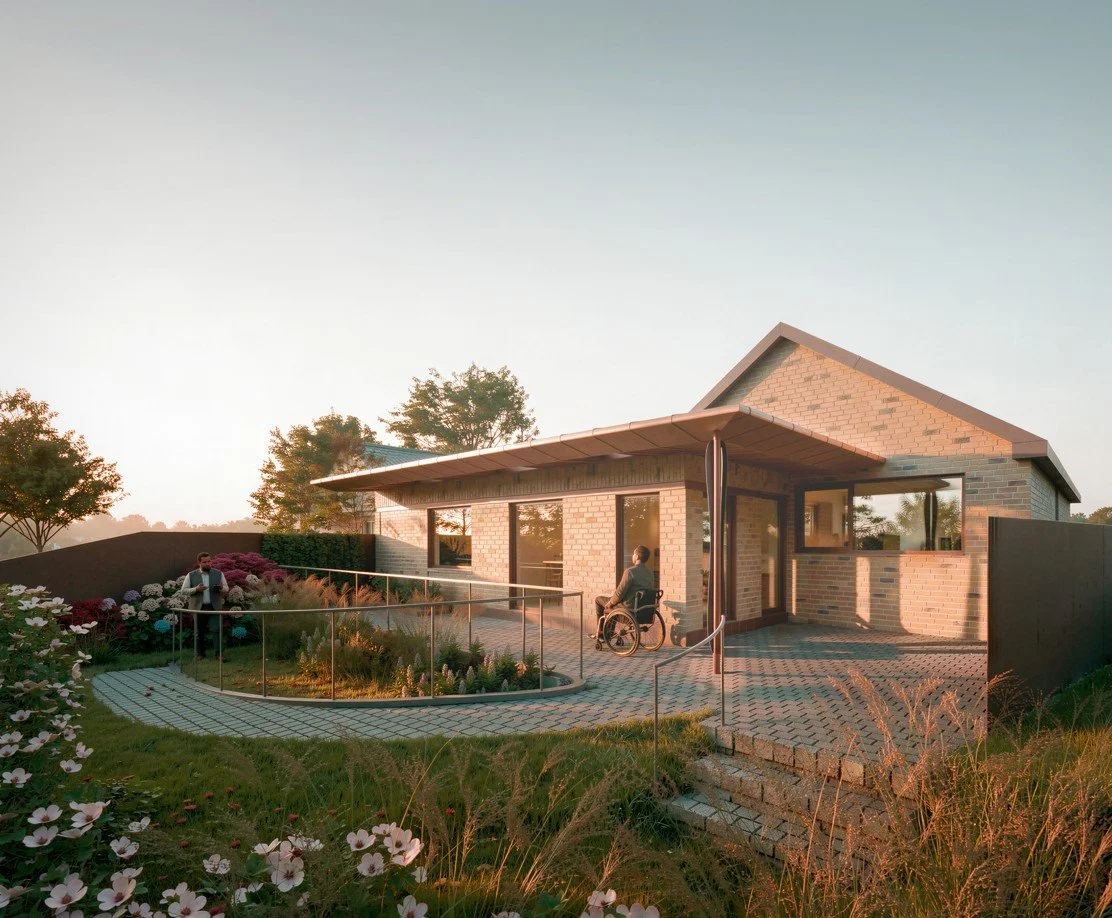
Rear extension designed for accessible living, where careful spatial planning avoided unnecessary floor area while improving usability and long-term adaptability.
Costs of an extension
Every unnecessary square metre still carries a cost. Foundations, structure, roof, finishes, services: it all adds up. The Federation of Master Builders puts a single-storey extension at £2,200–£3,000 per square metre in most of the UK, so ten square metres of corridor nobody needs is £22,000–£30,000 before you have bought a kitchen.
The pattern is the same on every project I have costed. The headline rate per square metre gets the attention, but the number of square metres and the number of junctions decide the bill. The table below shows where the money goes.
| What | What it does to the budget |
|---|---|
| Floor area | The whole build cost scales with it. Every m² carries footings, slab, walls, roof, finishes and heating. |
| Foundations and groundworks | Trees, drains and poor ground deepen footings and add cost per metre of wall. Less wall means less exposure. |
| Structural openings | Every junction between new and old, and every corner, means steel, padstones and lintels. Simple plans need fewer of them. |
| Glazing | Roughly 15% of a typical kitchen extension. Bespoke sizes cost far more than standard ones. |
| Roof form | A single flat or simple pitched roof is cheap. Valleys, parapets and multiple pitches are not. |
| Services | A new WC or kitchen far from the existing soil stack means long drainage runs and extra excavation. |
How to reduce extension costs without reducing quality
Cut circulation first. Corridors and halls are the most expensive space in a house because they do nothing. If a plan has a corridor longer than it needs to be, that is the first thing to redesign.
Give every room a job. A room that is nice to have on a plan is a room that gets built, heated and cleaned for twenty years. If you cannot say what it is for on a Tuesday evening, take it out or merge it with a room that has a purpose.
Use standard glazing sizes. Off-the-shelf doors and rooflights are a fraction of the cost of bespoke units and arrive faster, and typically mean fewer issues with the opening sizes.
Keep the roof simple. One pitch, or a flat roof with a decent upstand, costs far less than a roof that has to meet the existing house at three angles.
Fix the layout before anyone prices it. Changes made on the drawing cost a few hours of design time. The same changes made on site cost thousands and push the programme back. The £31,000 above was saved during the design stage.
All too often, designs look impressive because there is simply more space. Larger rooms sound good on paper but add little to day-to-day use, and extra floor area can darken the rooms behind it. Good spatial design is not about squeezing a house smaller; it is about making sure every part of it has a clear purpose.
Permitted development or planning permission?
A single-storey rear extension on a detached house in England can extend up to 4 m under permitted development, or 3 m on a semi-detached or terraced house, subject to the height, eaves and coverage limits in the General Permitted Development Order. Larger rear extensions, up to 8 m and 6 m respectively, go through the prior approval route. Anything outside those limits, or on a flat, in a conservation area or on a listed building, needs a householder planning application. The fee in England is £548 from April 2026.
Frequently asked questions
How much does a house extension cost per square metre in the UK?
The Federation of Master Builders puts a single-storey extension at £1,800–£3,800 per square metre for the build, more in London and the South East. Add VAT, professional fees, kitchen or bathroom fit-out and a contingency of 10–15%.
What is the cheapest way to extend a house?
Build less of it. A compact, well-planned extension with a simple roof, standard glazing and a short drainage run costs less per useful square metre than a larger one with none of those things. On a tight budget, a two-storey extension over the same footprint is often cheaper per square metre than a single storey because the foundations and roof are shared.
Is a smaller extension cheaper per square metre?
Usually not. Fixed costs such as scaffolding, site set-up and the openings into the existing house are spread over fewer square metres, so the rate goes up as the extension gets smaller. The total still goes down. The aim is the smallest extension that does the job properly, not the smallest extension.
Do I need an architect for a home extension?
Not legally. You need drawings for planning and Building Regulations, and anyone can produce them. What an architect adds is the layout thinking that decides whether you build 40 m² or 30 m² for the same result, and on most projects that decision is worth more than the fee.
Does an extension need Building Regulations approval?
Yes, every extension does, whether or not it needs planning permission. Structure, insulation, drainage, glazing, electrics and fire safety are all covered.
Talk it through before you draw it
If you are considering extending your home and want a layout designed for how you live rather than for the maximum floor area, book a free 20-minute call and I will talk it through with you.
Related reading: Why speak to an architect before you buy a home and What does an architect actually do?